ABRONA
01 — METHODOLOGY

How Abrona formulates.
How Abrona verifies.

A complete account of the Abrona process — from the initial ingredient brief to the closed batch archive. The methodology is not a quality claim; it is a documented set of procedures that each Abrona production cycle must satisfy before a lot is released.

PROCESS OVERVIEW
01 Ingredient Brief
02 Supplier Approval
03 Lot Coding
04 Production & Granulation
05 Third-Party Analysis
06 Archive & Release
02 — PRODUCTION CYCLE

Six steps. Every batch. No shortcuts.

01
INGREDIENT BRIEF

The formulation begins on paper, not in production.

Every Abrona formulation begins with a written ingredient brief — a document that establishes the target elemental profile, the rationale for each mineral and vitamin's presence, the minimum acceptable purity range, and the list of approved supplier categories. The brief is reviewed by two members of the formulation team before any sourcing activity begins.

Ingredient profiles in Abrona supplements are selected based on published nutritional research. The brief references the relevant published findings for each nutrient included and documents why the chosen form (e.g., bisglycinate over oxide for magnesium) was selected over alternatives. This brief is the permanent first entry in the batch record and is never modified after sourcing approval.

Abrona formulation brief document on a clipboard with a hand-written ingredient list and checkboxes on a clean wooden desk with natural window light and a cup of tea
02
SUPPLIER APPROVAL

Suppliers are approved before ingredients are ordered.

Active ingredients are sourced from documented suppliers, with each batch accompanied by a certificate of composition. Before any supplier is added to the Abrona registry, the sourcing coordinator conducts a facility review — either in-person for regional suppliers within Indonesia, or by documented remote audit for international partners.

Sourcing prioritises suppliers whose facilities maintain food-grade processing standards. The review covers processing hygiene standards, storage conditions, traceability records, and prior certificate history. Approved suppliers are added to the registry with a facility profile, first-contact date, and review revision number. The registry is the permanent reference against which all ingredient orders are checked.
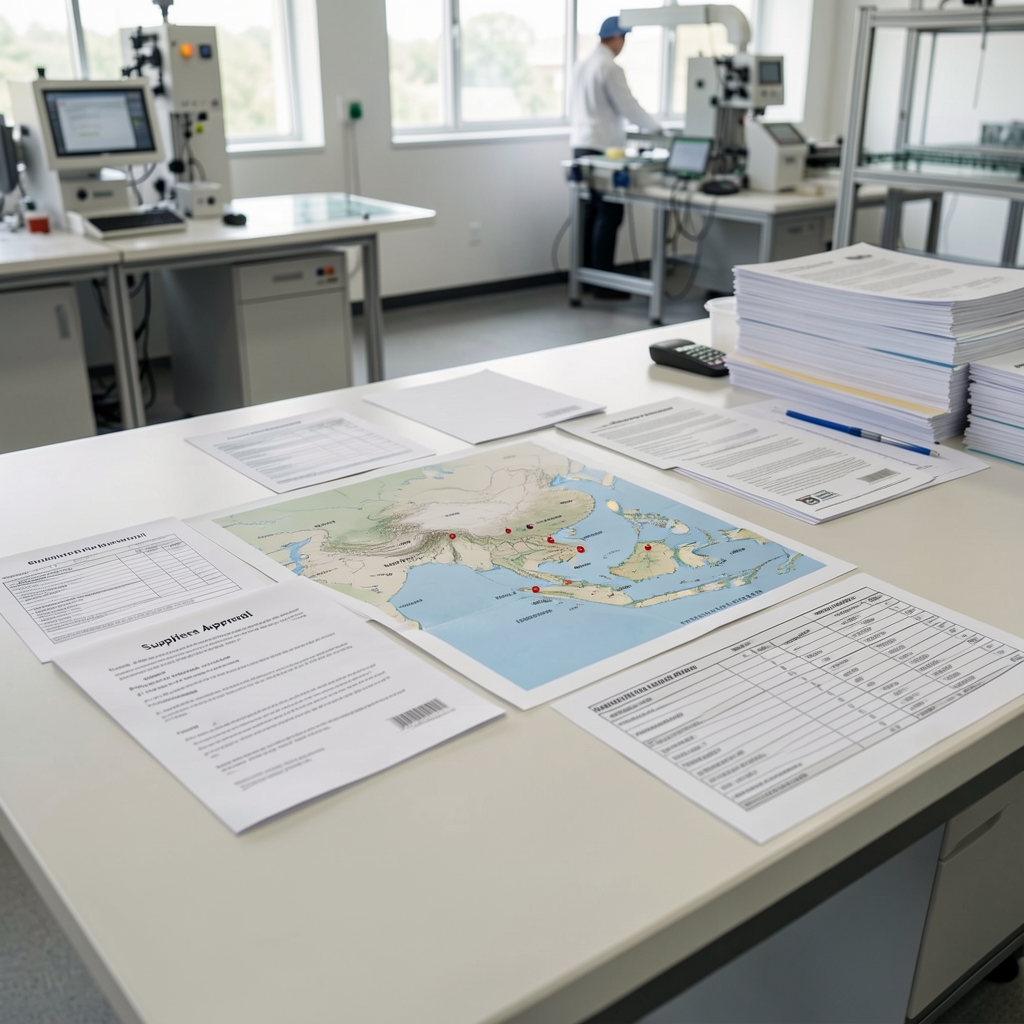
Sourcing documentation spread on a large table showing printed supplier approval forms, a regional map of Indonesia with highlighted supplier locations, and stacked ingredient specification sheets in a quality-control environment
03
LOT CODING

Each batch receives a unique lot code before production begins.

The Abrona lot coding system uses a structured format: ABR-[FORMULATION CODE]-[YEAR]-[QUARTER]-[SEQUENCE]. The lot code is assigned at the point of ingredient receipt confirmation and does not change through production. It is the primary key across the batch record, the production log, the verification certificate, and the archive entry.

FORMAT
ABR-F01-2026-Q2-003
RETENTION
5 years from release date
RETRIEVAL
Within 5 working days on request
04
PRODUCTION & GRANULATION

Ingredient ratios are fixed at production entry and logged against the lot.

The ingredient ratios established in the brief are the sole reference for production blending. Abrona uses a granulation step for all powder-matrix formulations to ensure consistent distribution of active minerals and vitamins within each capsule fill. The granulation parameters — particle size range, moisture target, blend time — are recorded as part of the production log.

Capsule shell selection uses food-grade gelatin for all current Abrona formulations. Shell dimensions and fill weight are logged against the lot code. The finished capsule containers are labelled with the lot number, the serving composition, and the full ingredient list before being sealed for transfer to the third-party verification facility.
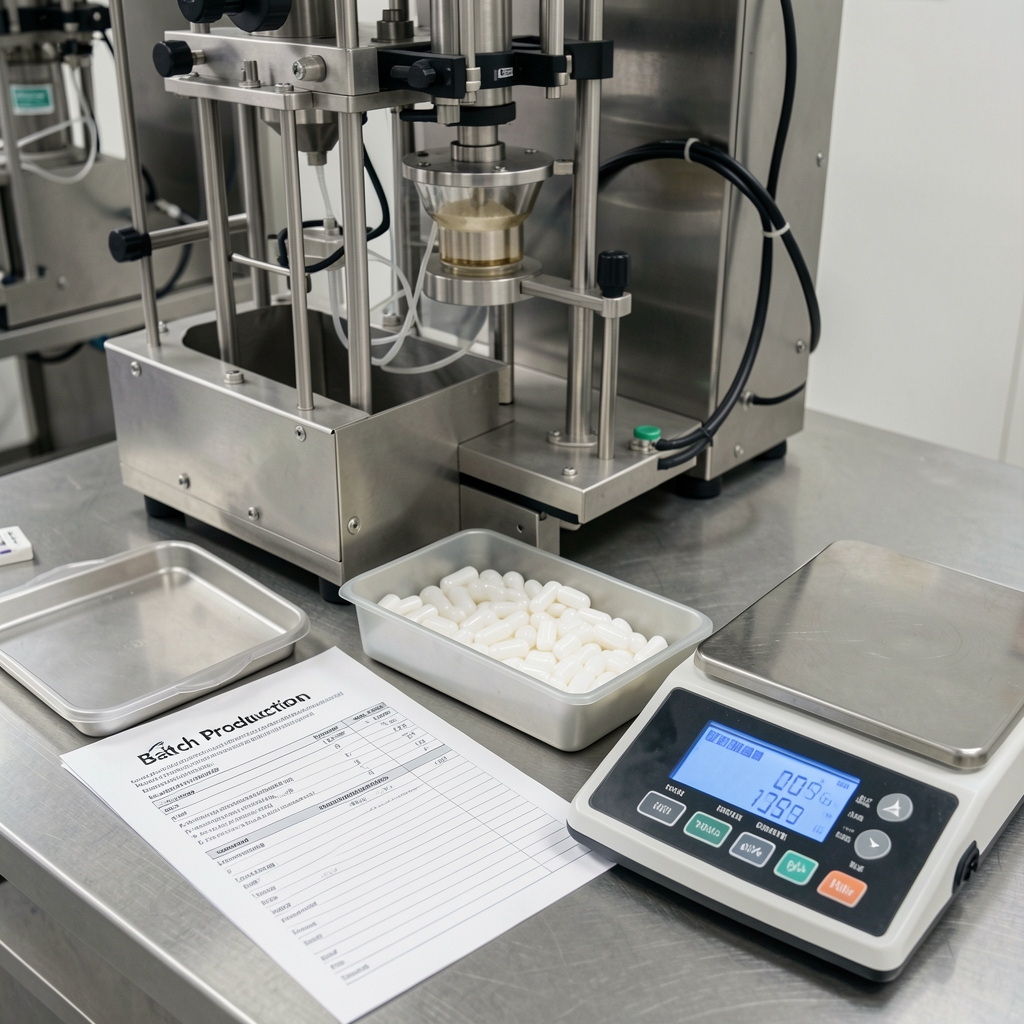
Production bench view of capsule filling equipment with white gelatin capsules visible in a tray alongside a printed batch production log sheet and a digital scale showing ingredient weight measurements
05
THIRD-PARTY ANALYSIS

Abrona does not self-certify. Every batch goes to an independent laboratory.

A sealed sample from each production batch is submitted to an independent third-party laboratory in Jakarta. The laboratory performs elemental concentration analysis and dissolution profile assessment. Results are returned as a formal certificate — not an internal report — issued under the laboratory's own letterhead and signed by the responsible analyst.

Ingredient profiles undergo independent batch verification for quality and labelling accuracy. The tolerance window accepted by Abrona is tighter than the regulatory minimum. Any batch whose analysis falls outside the accepted tolerance is not released — the lot code is closed, the batch is quarantined, and a new production cycle is initiated. This has occurred twice in the studio's production history, both times in 2020 during early process calibration.
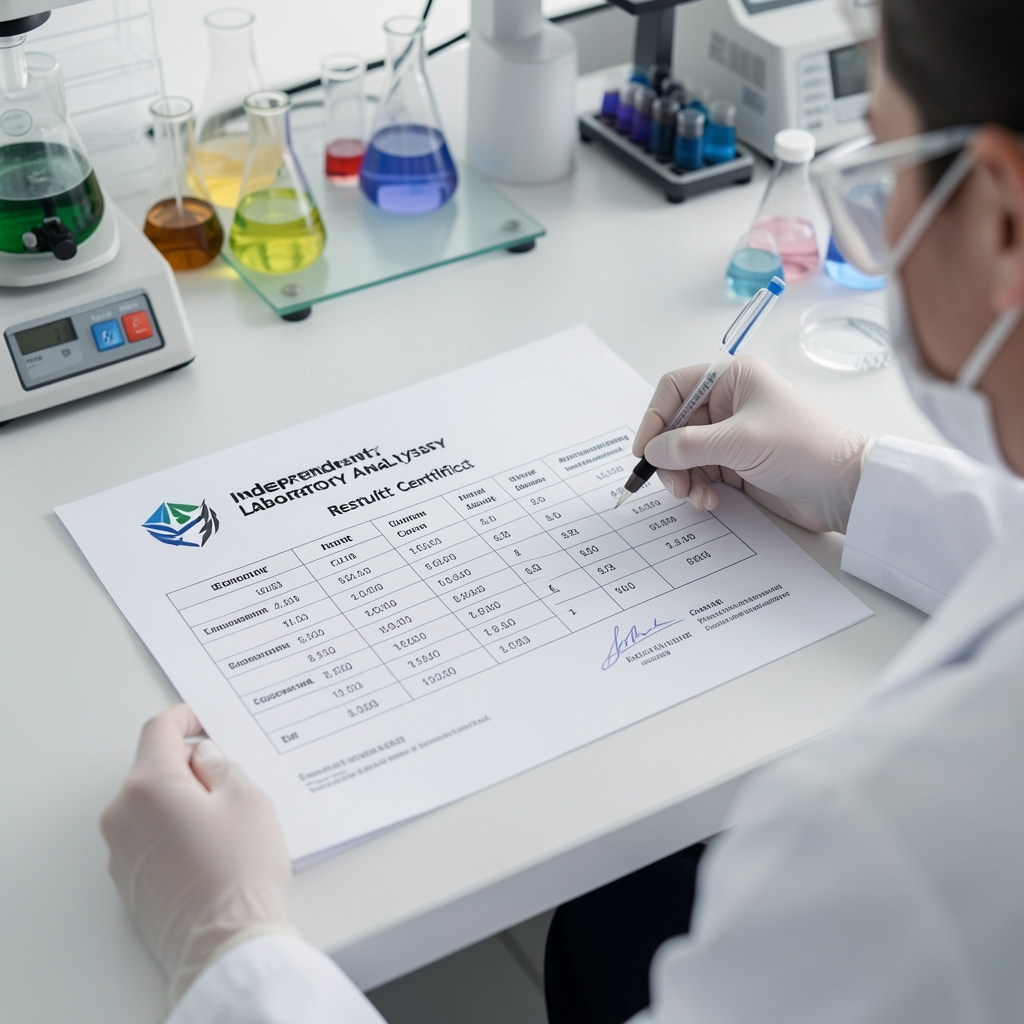
Independent laboratory analysis result certificate on a clean desk with printed columns of elemental concentration values, a laboratory analyst's signature block visible at the bottom, and sealed sample containers in the background
06
ARCHIVE & RELEASE

The batch record closes. The lot is released. The archive entry is permanent.

When the third-party certificate confirms that the batch is within the accepted tolerance window, the batch documentation officer closes the lot record. The close entry includes: the certificate reference number, the release date, the responsible signatory, and a revision stamp. After closing, the lot record cannot be modified — entries may be appended, but the base record is immutable.

The lot is released to distribution. The archive entry is retained for five years from the release date. Any consumer holding an Abrona container can request the batch certificate by submitting the lot number to [email protected]. The corresponding certificate is provided within five working days. The archive currently spans seven years of production history.
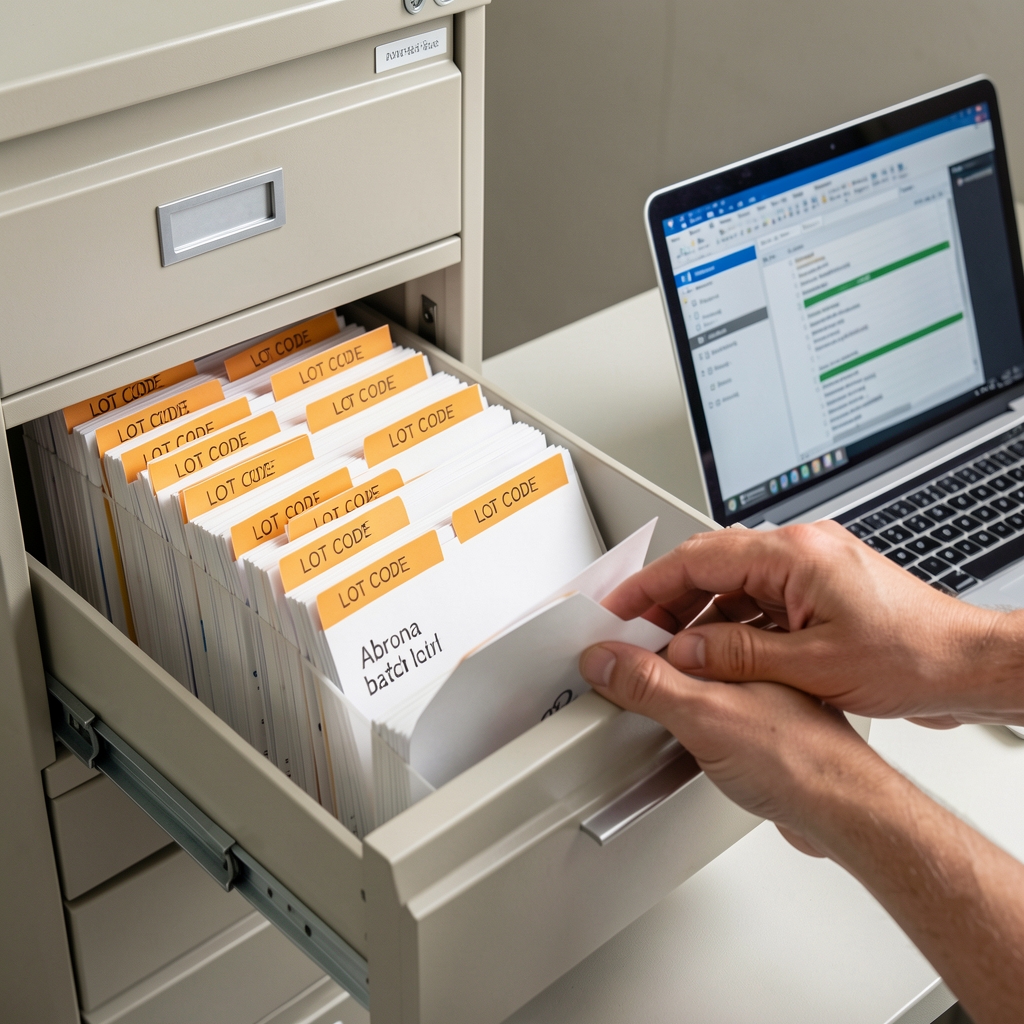
Abrona batch archive filing cabinet drawers open showing neatly labelled folders with lot code tabs in amber font on white card, a hand reaching to pull one folder, and a digital archive system visible on a laptop screen beside it
03 — SUPPLIER STANDARDS

The registry. The review cycle. The sourcing criteria.

REGISTRY CRITERIA

Suppliers enter the registry only after a documented review.

The Abrona supplier registry currently lists eleven facilities. Each entry records the facility name, location, the date of initial approval, the scope of approved ingredients, and the revision number of the most recent review. New suppliers are not used for production until their registry entry is complete and signed by the sourcing coordinator.

  • Facility must maintain food-grade processing standards
  • Prior certificate of composition on file for the specific ingredient
  • Documented traceability chain from raw material origin
  • Minimum 24-month supply history with no critical non-conformance
REVIEW CYCLE

Suppliers are reviewed annually. Registry entries are versioned.

Each supplier in the Abrona registry is subject to an annual review. The review assesses whether the facility's food-grade processing standards remain current, whether any change in ingredient specification has occurred, and whether the prior certificate of composition still accurately represents what the supplier is delivering.

When a review is completed, the registry entry is updated with a new revision number and date. If the review identifies a material change in the supplier's specification, the formulation team is notified and the affected ingredient brief is reviewed before the next production cycle begins. Suppliers who fail the annual review are suspended from the registry pending resolution.

ORIGIN MAPPING

Each ingredient's geographic origin is recorded with the lot.

The Abrona origin map records the production or processing region for each active ingredient in the current range. Regional sourcing is prioritised where food-grade supplier options exist within Indonesia. For ingredients where no approved domestic supplier meets the registry criteria, international partners are used — all subject to the same approval process as domestic facilities. The origin map is updated with each new supplier entry and each production lot record.

COLD-CHAIN COMPLIANCE

Temperature-sensitive ingredients travel under documented cold-chain conditions.

Several Abrona ingredients — notably the CoQ10 ubiquinone and the vitamin D3 lanolin extract — require controlled-temperature handling during transit. Each cold-chain shipment is accompanied by a temperature log from the supplier facility to the Abrona intake area. The log is filed with the ingredient receipt confirmation and cross-referenced against the lot record. Any shipment that shows a temperature excursion outside the specified range is quarantined and not used in production until the supplier issues a new certificate confirming the ingredient specification has not been compromised.

04 — VERIFICATION STANDARDS

Third-party. Every batch. No self-certification.

ANALYSIS METHOD

The independent laboratory performs elemental concentration analysis using an established analytical method for food-supplement samples. The analysis covers all active mineral and vitamin components listed on the label. Results are returned as a quantified concentration value for each element, not a pass/fail summary.

TOLERANCE WINDOW

The acceptable variance between the labelled quantity and the measured batch quantity is held to a tighter standard than the Indonesian food-supplement regulatory minimum. This means the label quantity is a conservative statement of what the batch contains — not a ceiling. Batches outside tolerance are not released.

CERTIFICATE FORMAT

Each certificate is issued by the independent laboratory on its own letterhead, references the Abrona lot number, and is signed by the responsible analyst. Abrona does not alter, reformat, or summarise the certificate — the document filed in the archive is a direct copy of the laboratory's original issue.

REQUEST A CERTIFICATE

Any Abrona consumer can request the batch certificate for a container they hold. Submit the lot number printed on the container label to [email protected]. The certificate will be provided within five working days. Lot records are retained for five years from the release date.

05 — REGULATORY STATUS

Food-supplement classification. Indonesian regulatory registry.

Abrona products are nutritional food-supplements registered with the applicable local regulatory authority under food-supplement classification. Products meet compositional and labelling requirements for nutritional supplement categories.

The food-supplement classification means Abrona products are produced, labelled, and distributed as nutritional provisions. The ingredient brief, the batch record, and the labelling are all produced within this classification framework.

We recommend speaking with a qualified wellness or nutrition professional before introducing any supplement to your daily routine, particularly if you have specific dietary requirements. The Abrona formulation team is not qualified to provide individual nutrition guidance — enquiries about batch records, ingredient sourcing, and formulation composition are handled through the contact page.

06 — METHODOLOGY FAQ

Frequently asked questions about the Abrona production process.

Additional questions can be submitted via the contact form. Process-related questions are answered within three working days.

Every production batch — regardless of formulation — undergoes independent third-party analysis before release. Abrona operates on a quarterly batch cycle, meaning each formulation is verified four times per year at minimum. There is no carry-forward: a prior certificate does not cover a subsequent batch.

The lot is quarantined. The batch record is closed with a non-release notation, and the lot number is retired — it will not appear in distribution. The formulation team initiates a root-cause review, which covers both the production process and the supplier certificate for the relevant ingredient. A new production cycle begins only after the root cause is identified and corrected. This process has occurred twice in the studio's history, both in early 2020.

A summary of the ingredient brief — covering the rationale for each nutrient's inclusion and the form selected — is available on request. The full brief (including supplier registry references) is an internal document and is not distributed. Requests for summaries should be directed to [email protected] with the formulation code (e.g., ABR-F01) in the subject line.

Production blending and encapsulation is carried out at a food-grade partner facility in Jakarta, operating under a formal production agreement that requires compliance with the Abrona batch documentation protocol. The formulation team is present during each production run. The Abrona sourcing and batch documentation roles remain in-house — the partner facility does not have access to the supplier registry or the archive system.

The Abrona verification laboratory is selected on the basis of accreditation status, method capability for the specific elemental analysis required, and independence from any Abrona supplier relationship. The current laboratory partner has been in place since the first verification batch in 2020. Its selection is reviewed every two years as part of the studio's audit calendar. The laboratory name and accreditation details are available upon written request.

NEXT STEP

Explore the six formulations or request a batch certificate directly.